

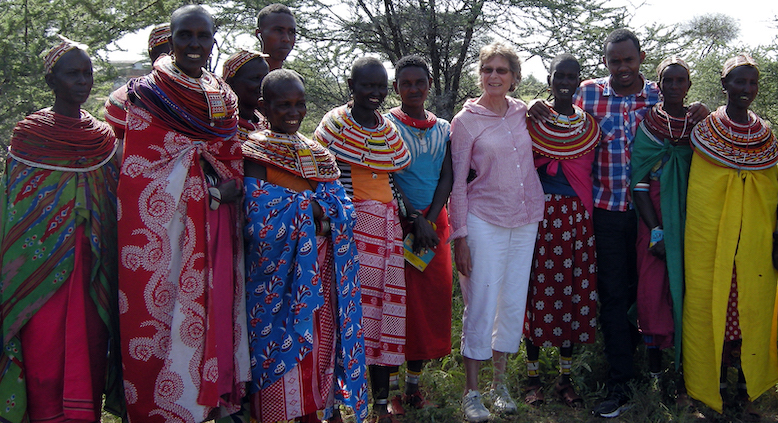
“Opening up markets for this underutilized dryland resource will greatly benefit the pastoralist communities.”
Hilary Sommerlatte

Hilary Sommerlatte became intrigued on African indigenous ingredients at an early age, when she learnt that Kenyan indigenous African olive was the same species as the European olive. Supported by Montpellier Institute of Agriculture, and already a graduated botanist, she traced the origins of the European olive and found herself closer to what would soon be her vision: to bring Kenyan indigenous ingredients to the world.
Since then, Hilary hasn’t stopped researching and opening new markets for the somewhat unknown or unrecognized African indigenous ingredients. Such is the case with her work on Cape Chestnut tree, for which she established a world market in 2002. Fascinated by wild harvesting practices, their methods, and the impact these could have on communities and the land, she soon became interested in Kenyan Frankincense.

Collectors at work!
Born and raised in Kenya, Hilary focuses on wild harvesting, seeking to empower women, and on promoting alternative sources of income in the deserted north Kenyan region where pastoralism is the main source of income. “The collectors are women by default as the men overall do not collect gums as they see it beneath them. Their whole focus is owning livestock and everything to do with livestock. The women need to be independent to provide for their children, if the men don’t buy the food and educate their children. It is therefore important that they own their own incomes and can make decisions on how their money is spent.” states Hilary and we couldn’t agree more. Recent studies by UNDP state that: “Despite women’s central role in agriculture production, only around 10% of land titles are issued to women. When the hectare size of titles is considered, this translates into only 1.62 percent of agricultural land being owned by women” (p.6). This project offers women a steady source of income that can then offer food and schooling security for the women’s children, a brighter future for all!

Arbor Oils of Africa was born in 1952 and, since then, the team has been working non-stop in promoting, creating and establishing a market, and identity, for the lesser-known Frankincense and Myrrh species from Northern Kenya: The Kenyan black frankincense, that comes from Boswellia neglecta and Commiphora confusa. Today, Arbor Oils has its own distillation plant and is steadily entering the international market. We feel privileged to be part of this adventure, on aiding Arbor Oils to establish a presence in the European market and assist the women from the semi-desert northern Kenya on bringing their magical product, to the world.
This project:
Empowers women: Collectors are mainly pastoralist women, who are trained in sustainable harvesting techniques
Tapping Free Collection (Wild harvest): The harvest is from natural exudation; the trees are not cut in any way. The gum is induced by the chewing activity of beetle larvae and the gums are scraped off by the collectors. After the rainy season a collector can collect up to 10kg a day.
Traceable products: As the purchase center is in a remote area, with no lodgings, Hilary and her team travel for approximately six hours to the remote and insolated collecting area. The team camps and the next day, collectors bring their gums by donkey; the gums are weighed and labelled, and the collectors are paid cash. The gums are then transported to the distillation plant, for steam distillation.
Production capacity: 800 kg.
Certification: Arbor Oils has been certified organic since 2007; FairWild certified in 2014 and 2015. Arbor Oils renewed its FairWild certification in 2022. Products from the wild harvest collection are sustainably sourced, fair trade, traceable and free from contamination.
Curious about Arbor Oils of Africa? Visit them!

0 Comments