


In European botanical sourcing, hibiscus sits in a high-attention category: widely used across infusions, natural colour, food applications and wellness blends, yet routinely assessed against a tight risk checklist. The key concerns are consistent across procurement teams, pesticide residues, microbiological and contaminant controls, and physical cleanliness (foreign matter, sand, stems, insects). Market guidance for hibiscus exporters from the Centre for the Promotion of Imports (CBI) frames these as mandatory market-entry realities, noting that non-compliance can prevent hibiscus from entering the European market.
That pressure has been sharpened by how regulatory defaults work in practice. The European Commission notes that where a pesticide is not specifically listed, a default maximum residue level (MRL) of 0.01 mg/kg applies, a baseline that pushes conservative residue risk management and documentation discipline throughout the supply chain.
Against this backdrop, Comttraex Nig Ltd is positioning its hibiscus through a proof-first lens: product specs, third-party certification, and stated batch testing, the kinds of signals European procurement teams tend to look for when moving from sample approval to repeat shipments.
A market lesson written in border controls
Nigeria’s role as a major hibiscus origin is well established, but its export history also illustrates why hibiscus compliance is more than paperwork. Nigeria’s Agricultural Quarantine Service (NAQS) has stated that Mexico suspended imports in 2017 after a storage pest was detected in some consignments, and that the ban had significant commercial consequences. The episode is less about Mexico specifically than about the underlying point: trade interruptions in botanicals often trace back to post-harvest systems — drying, storage hygiene, pest management, handling practices and inspection readiness — and scrutiny tightens quickly when those systems fail.

The product profile: Specifications that speak to the “intake test” moment
Comttraex’s published hibiscus specifications put the variables most commonly checked at intake up front. On its product sheet, the company lists hibiscus from Northern Nigeria with the following baseline specifications: moisture 12% max; foreign matter 1% max; colour dark red/burgundy; and formats offered as full flower or siftings. It also lists standard trade documentation, including certificate of origin, phytosanitary certificate and fumigation certificate (if applicable), alongside “other documentation as may be required”.
It is the kind of spec language buyers use to build receiving standards, sampling plans and contractual tolerances — and it becomes meaningful only when it holds consistently across lots and seasons.
A defined process scope: sorting, sifting, and control

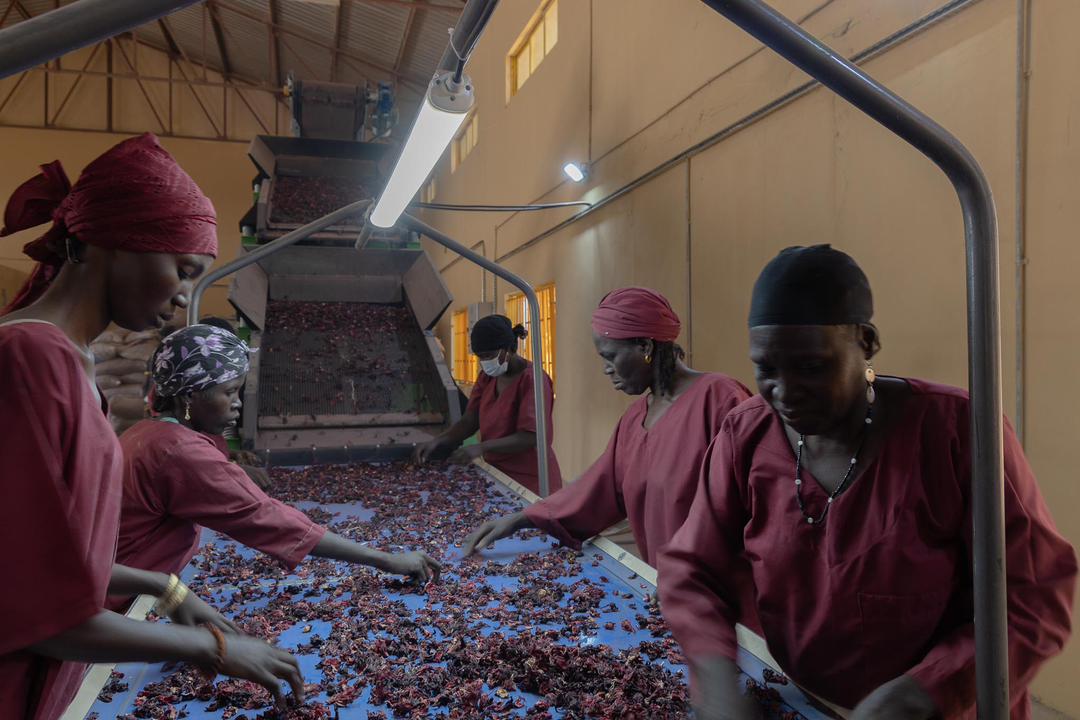
Beyond the spec sheet, Comttraex references a HACCP Certificate of Compliance that describes the scope of its operation as processing raw hibiscus through mechanical sifting and handpicking to produce full flowers and siftings for consumption, with validity dates shown as 03 June 2025 to 02 June 2027. For procurement teams, this matters because foreign matter and physical cleanliness are often decided by the effectiveness of sorting and the controls around it — including how the product is handled before and after sorting, how batches are separated, and how traceability is maintained.

Organic positioning that can be verified
Ecocert’s public directory lists Comttraex Nigeria as certified under Organic Agriculture Europe (EU 2018/848) and Organic Agriculture USA (USDA NOP). In practice, organic sourcing is increasingly operationalised through digital compliance steps. In the EU, organic imports typically involve a Certificate of Inspection (COI) managed through TRACES NT, while the UK maintains its own COI requirements and timelines for imports into Great Britain.
For buyers, supplier readiness here is not only about presenting certificates, but about supporting COI workflows and documentation timelines in a way that aligns with inbound logistics.
Residue risk and testing: the claim Comttraex is leaning into
CBI’s hibiscus guidance is explicit that compliance with MRLs, contaminants and microbiological requirements is mandatory, reinforcing the need for consistent contamination prevention and verification. Comttraex has leaned into that reality with a clear public claim: on LinkedIn, the company states that every batch is lab-tested by Eurofins for safety and quality, alongside traceability and certification claims. As with any supplier statement, the operational proof sits in the evidence buyers typically request — recent certificates of analysis (COAs), scope of testing, lot definitions and sampling protocols.
Logistics and fulfilment: reducing friction for Europe
A repeated pain point in botanical procurement is execution: lead times, corrective actions, document corrections, and the ability to respond quickly if an inbound batch requires further checks. Comttraex has indicated it is establishing a German entity (Comttraex UG) to serve European clients with faster logistics, EU warehousing and local invoicing. The commercial value of that proposition depends on how it is operationalised — inventory model, Incoterms, lead-time commitments and documentation handling — but the intent is clear: reduce friction for EU buyers once supplier approval is in place.
What Comttraex is bringing to BIOFACH 2026
BIOFACH 2026 runs from 10–13 February 2026 in Nürnberg. Comttraex is presenting hibiscus full flower and hibiscus siftings at the Organic Africa Pavilion (Hall 1). On packaging, Comttraex’s published guidance suggests 20kg PP bags for full flower (12–13 tonnes per 40′ container) and 30–40kg PP bags for siftings (18–20 tonnes per 40′ container), with custom packaging possible.
The buyer takeaway: a supplier narrative built around verifiability
Across its public materials, Comttraex’s positioning follows a logic aligned with how European procurement teams de-risk botanical sourcing: start with measurable specs; support process credibility through defined food safety scope; anchor claims in verifiable certification; address residue risk through stated batch testing; and reduce operational friction through an EU fulfilment presence. In a hibiscus market where compliance determines market access — and where documentation discipline increasingly shapes procurement decisions — Comttraex is presenting itself as a supplier built for the audit trail as much as for the sample.




0 Comments