

Uganda’s organic sector rarely needs an introduction inside specialist trade circles, but it is often still underestimated in one crucial respect: scale International organic statistics continue to place Uganda among the world’s most significant producer bases, not as a niche origin but as a high-volume smallholder ecosystem with a growing number of export-ready value chains.
That scale did not happen by accident. Uganda’s organic trajectory has been shaped by a blend of market pull (especially from Europe), farmer-led adoption, and a gradually strengthening institutional backbone. Central to that backbone is the National Organic Agricultural Movement of Uganda (NOGAMU), the country’s apex body for organic agriculture and a key reference point for how the sector organises itself around standards, certification support, training, and market access.
For buyers, Uganda’s relevance sits in a specific combination: a large producer base, a diversified organic export basket, and an increasingly formal policy and standards environment. The sector’s maturity is not best judged by promotional claims, but by the structures that enable repeatable compliance: recognised standards, internal control systems, traceability pathways, and the ability to coordinate thousands of producers into consistent export flows.
A producer base that changes what “sourcing from Uganda” can mean
In global organic conversations, “producer numbers” can feel abstract. In Uganda, they are a practical indicator of supply architecture: group certification models, farmer organisations, and internal control systems (ICS) that are designed to keep smallholders inside export pathways.
Uganda stands out in the most recent FiBL/IFOAM organic statistics as Africa’s leading country by both organic land area and number of producers, underscoring the breadth of the sector and the volume potential across multiple crops. This is an important framing for sourcing teams because it shifts the conversation from one-off supply relationships to programme-style procurement: multiple regions, multiple harvest windows, multiple farmer groups, and the need for consistent documentation and verification.
This scale also helps explain why Uganda’s organic basket is so diverse. Organic supply is not concentrated in a single flagship commodity; it has expanded across beverages and spices, oilseeds and fruits, as well as a growing set of processed formats that reduce perishability and create more stable logistics.

NOGAMU’s role: the sector’s coordinating body, not a single exporter
NOGAMU is often encountered through trade fairs, matchmaking, or sector programmes, but it is best understood as a coordinating movement rather than a commercial exporter. Founded in 2001 and registered as a not-for-profit company limited by guarantee, it brings together actors across the organic value chain: farmers, processors, exporters, traders, and business support organisations.
Its footprint is sizeable. NOGAMU’s membership network has grown to 360+ corporate member organisations, indirectly representing more than two million smallholder farmers. That structure matters because it indicates how the sector can be convened around common requirements: standards interpretation, certification facilitation, quality practices, and export-readiness support.
Policy and regulation: Uganda’s organic sector is being formalised
Uganda’s organic development has long been market-driven, but policy has increasingly caught up. The National Organic Agriculture Policy (NOAP) was launched by the Ministry of Agriculture, Animal Industry and Fisheries in 2020, the product of collaboration among government, NOGAMU and other sector stakeholders.
The policy is explicit about why formalisation matters: it frames organic agriculture as a strategic pathway for competitiveness, coordination, and regulation, and it sets out a basis for an eventual Organic Agriculture Bill to support regulation of the sub-sector.
For sourcing teams, the significance of NOAP is not the rhetoric; it is the direction of travel: organic is moving further into a framework of national strategy, standard-setting, and sector coordination. That tends to improve clarity around roles, strengthens quality infrastructure over time, and creates stronger alignment between exporters, certifiers, and public institutions.
Standards and certification: the practical infrastructure behind “organic”structure: own orchard plus producer networks
In Uganda, organic compliance is widely operationalised through group certification models — essential for a sector built on smallholders. The economics of certification make group structures and internal control systems central: training, inspection readiness, record-keeping, and ongoing compliance become part of a managed system rather than a one-off event.
NOGAMU’s work explicitly includes development of internal control systems and support through inspection and certification steps. In parallel, the broader East African region has invested in harmonisation through EAOPS, a standard that is referenced across organic value chain actors in Kenya, Uganda, and Tanzania and has been the subject of formal baseline research to assess uptake and compliance.
At the same time, the certification landscape continues to evolve. Uganda has also positioned a national organic certification body — UgoCert — as part of its quality infrastructure, a signal of increasing institutional maturity in how certification services are accessed and delivered.
The buyer relevance: what Uganda’s organic “ecosystem” actually offers
Uganda’s organic sector is best understood as an ecosystem built for volume and diversity — and increasingly, for structured compliance. The presence of a strong sector movement, a national policy framework, a regional standards landscape, and evolving certification capacity makes it easier to build sourcing relationships that are scalable beyond single shipments.
The practical implication is that Uganda can support buyer models that require:
-multiple farmer groups under one compliance architecture,
-crop diversification without losing documentation discipline,
-supplier development pathways (training and post-harvest upgrades), and
-long-term procurement that grows alongside certification coverage.
In a market where organic sourcing is increasingly judged by audit readiness rather than storytelling, Uganda’s strongest signal is the institutional one: a sector that has developed systems — and continues to formalise them — to keep smallholders inside export-grade organic supply chains. NOGAMU sits at the centre of that story, acting as the convener and translator between farm-level practice and market-level requirements.
A buyer-relevant origin story—with operational substance behind it
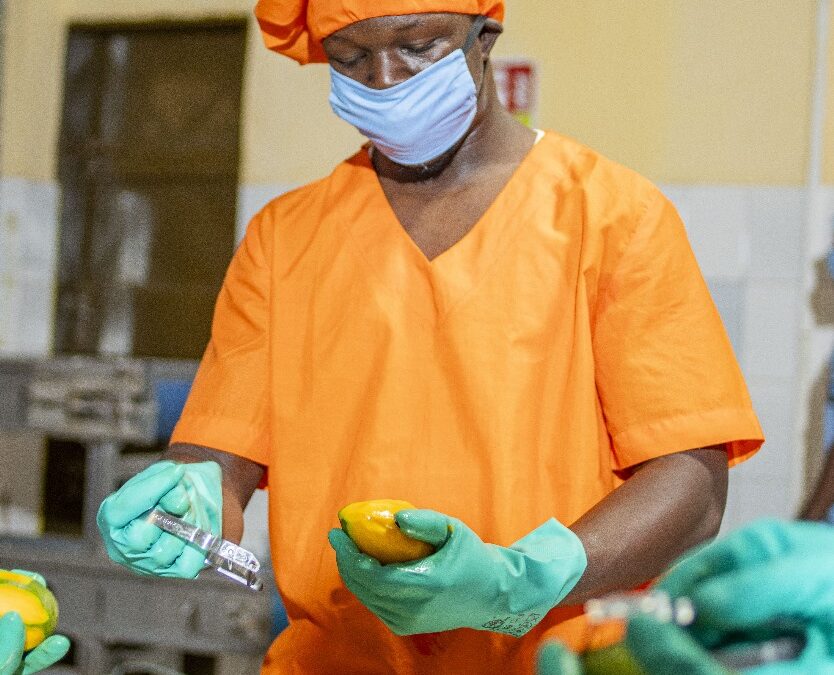
Burkina Faso’s dried mango reputation is sometimes told through culture and origin narratives; procurement decisions are made through consistency, documentation, and operational credibility. Rose Éclat sits at the intersection of both: a founder story anchored in early export ambition, and an operation defined by capacity, workforce realities, and a sourcing model that links orchards and producer networks to industrial processing.
In a category where competition is increasingly decided by reliability rather than novelty, the most useful signal is often the simplest: an ingredient supplier that can demonstrate repeatable output and the discipline to support it with the documentation European supply chains require.



0 Comments